Our French Riviera travel guides and itineraries include transportation guides for each town, giving you the best routes to take and guides to the different transportation modes.
Check out our guides for how to get around Nice or Cannes, or learn about Monaco’s many transportation options. Here’s a quick overview:
Arriving By Plane
The Aéroport Nice Côte d’Azur is the main hub for the French Riviera and France’s third-busiest airport — the busiest outside Paris, with 15.2 million passengers in 2025. Check out our guide to the Nice airport, direct flights, and transportation options from the airport.


The French Riviera By Car
If you plan on staying in just one spot, like Nice or Cannes, or staying along the coastal towns, don’t worry about renting a car. These towns are pedestrian-friendly, so you can walk almost anywhere or easily hop a train or bus to a nearby village. Plus, traffic in and out of Cannes and Monaco is notoriously bad and parking spaces are tough to find in the summer.
Uber and Bolt (which is the same as Uber but cheaper) operates throughout most of the Côte d’Azur (except for Monaco, where you can get dropped off but not picked up) and is a much easier option than calling a taxi or waiting for one at a designated taxi stand.
That said, French road trips just don’t get more glamorous than this: cinematic views, searing sunshine, art history aplenty and the Mediterranean around every turn. Cruising the Côte d’Azur is the French road trip everyone has to do at least once in their lifetime.
This is, above all, a place to take your time, stopping where fancy dictates.
The downside is that the French Riviera has some of the most treacherously narrow roads, worst traffic, scary-tight parking lots, and one of the highest traffic accident rates in France. The toxic mix of French car driving enthusiasm with many powerful motorcycles and youths on small scooters makes holiday motoring often an unrewarding experience.
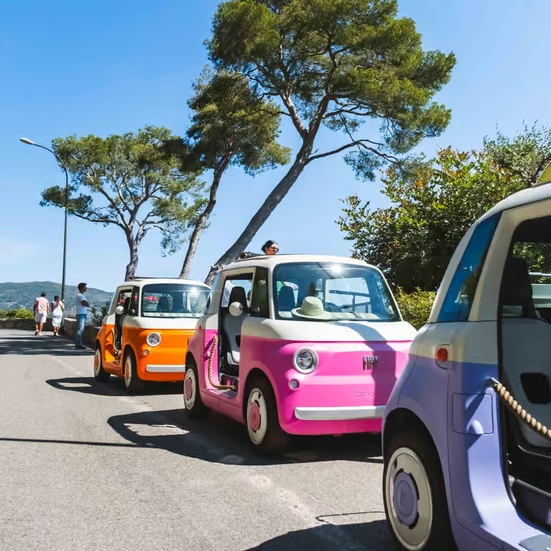
If you’re driving during peak hours, it can take 3 hours to get from Antibes to Monaco, whereas Google might tell you it’ll only take 45 minutes. It’s always better to travel by train (which takes around the same amount of time as driving if there’s no traffic) if you’re going from city to city during peak season or peak hours (roughly 8am to 10am and 4pm to 6pm).
Be aware that parking a car in many areas of the French Riviera is notoriously difficult (and sometimes literally impossible to find a spot). The amazingly-narrow turns in the lots scrape up many cars, so if you’re renting, make sure you have insurance. People park everywhere, between trees, poles and sometimes even on sidewalks, and parking tickets are doled out like candy. Drivers routinely bump each other in order to get in and out of tight spaces.
You may also want to be aware that gas prices in France are some of the highest in Europe. The government publishes a map of all the gas stations and their prices so you can compare before choosing where to fill up.
The Corniches

This trio of corniches (coastal roads) hugs the cliffs between Nice and Monaco, each higher than the last, with dazzling views of the Med. From fashionable residential capes, Belle Époque resorts, medieval villages, and picturesque hills, the Corniches do not lack anything when it comes to breathtaking views.
Filmmakers, writers, celebs and artists have all had their hearts stolen by this glittering stretch of coastline: by the end of this trip, you’ll understand why. From film town Cannes to down-to-earth Nice, via the corkscrew turns of the Corniches and into millionaires’ Monaco, it’s a drive you’ll remember forever.
The windy Corniche Drives were named after ‘cornices’, the decorative friezes that run along the top of elegant buildings. Try to avoid the dreadful summer traffic in July and August, but any other time is a dream.
Here’s a guide to the Corniche roads and some of the sights along the way:
And you can take a tour via Google Maps:
Above: the Corniche Inférieure
The Corniche Inférieure (D6098) skirts the glittering shores, and villa-lined waterfront between Nice and Monaco, with numerous swimming opportunities. Built in the 1860s, it passes through the towns of Villefranche-sur-Mer, St-Jean-Cap-Ferrat, Beaulieu-sur-Mer, Èze-sur-Mer and Cap d’Ail.
Up in the hills, the jewel in the crown of the Moyenne Corniche (D6007) is the medieval village of Èze, spectacularly perched on a rocky promontory offering awe-inspiring views of the coastline. Cut through rock in the 1920s, it takes drivers from Nice past the Col de Villefranche (149m), Èze and Beausoleil (the French town bordering Monaco).
And then there is the dangerous Grande Corniche (D2564), snaking along the 500m-high cliffs. This underdeveloped road is often engulfed in fog and at times too narrow for cars to pass each other without coming to a near stop. On a clear day, views from the spectacular cliff-hanging Grande Corniche are mesmerising, and you’ll probably want to stop at every bend to admire the unfolding vistas. There are no villages of note along it until you reach hilltop La Turbie, best known for its imposing Roman triumphal monument.
Hitchcock was sufficiently impressed by Napoléon’s Grande Corniche to use it as a backdrop for his film To Catch a Thief (1955), starring Cary Grant and Grace Kelly. Kelly died in September 1982 after her car left the road on the way down from Roc Agel to Monaco — not on the Grande Corniche itself, as is often written, but on the D37, the hairpin descent from La Turbie towards Cap-d’Ail. Nevertheless, this stunning trio of coastal roads offers the most outstanding overview (literally!) of the Riviera.

The Highway
The (less scenic) A8 motorway / highway, or “La Provençale,” connects Nice to the Esterel and then on to Aix-en-Provence in the west and Menton and the Italian border in the east. The 930-kilometre (580-mile) drive from Paris to Nice takes closer to nine hours once you allow for traffic and stops, with around 85 euros in tolls.
Breakdowns and Accidents
If you break down on a motorway in France, even if you have European breakdown recovery in place, your first call shouldn’t be to the RAC (roadside assistance service). French motorways are privately managed so instead of calling the RAC, first use the emergency telephones – these are orange and positioned every 2km along the motorway. If you can’t get to one of these orange phones, call emergency services by dialing 112.
Ride-Share Apps
Bolt and Uber are both available on the French Riviera. Bolt is basically the same as Uber, but slightly cheaper (and a more ethical company).
BlaBlaCar is a ride-share that you can book on their website or in the app. Nice to Monaco typically runs 3 to 8 euros; the airport run is longer, dearer and less often offered.
Klaxit, the carpooling app, became BlaBlaCar Daily in June 2024 — same scheme, new name. Journeys to and from Monaco are free for passengers, subsidised by the Princely Government, which pays the driver instead. It is open to anyone travelling to or from Monaco, and if your carpool home falls through, a taxi is reimbursed up to 50 euros.
What to keep in mind:
- Surge Pricing: Both Uber and Bolt use dynamic pricing. During busy periods (typically 8am to 11am and 6pm to 8pm), bad weather, or after a major event, ride-hailing apps can surge.
- Luggage Space: If you have multiple large suitcases, be mindful that the cheapest Uber/Bolt tiers (like UberX) are usually standard sedans. You may need to upgrade to an UberXL or larger Bolt if you need extra trunk space, which will increase the price.
The Famous French Riviera Train Routes
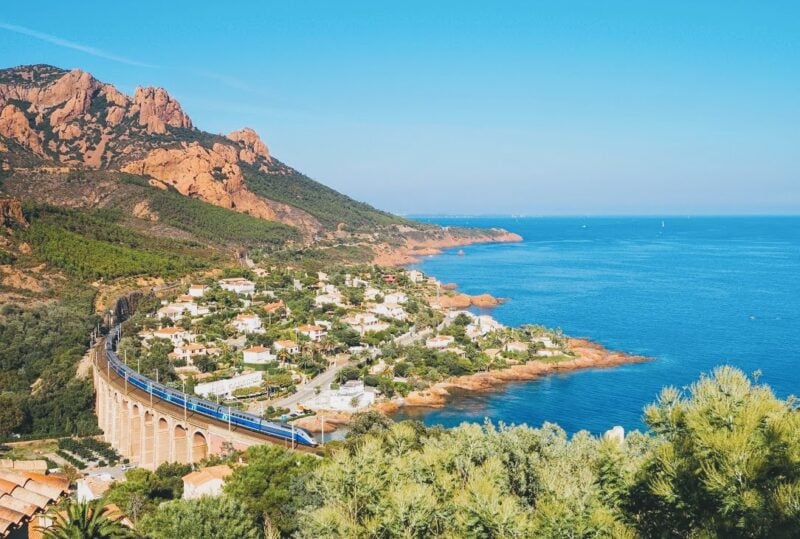
Train is the best, fastest, and easiest way to travel along the French Riviera. With stops in every seaside town, and lovely views along the way, it’s the area’s preferred mode of transportation. The rail system links the French Riviera to other destinations throughout France, as well as major European cities.
Local Trains
The Regional Express Train, or TER, connects the coastal cities throughout the Riviera, from Frejus to San Remo over on the Italian Riviera. On the busiest stretch, Cannes to Menton, trains run about every 15 minutes on weekdays, dropping to every half hour in the evening. Most stations sit within walking distance of the town centre, or have a bus service from the door. You can buy tickets from machines at each station — just stamp yours in one of the validation machines before boarding.
Both TER (regional trains) and SNCF (national trains) are on the SNCF website and the SNCF Connect app. It’s best to download the app onto your phone so can buy your tickets and see timetables in advance before arriving at the train station to depart. It saves time at the station and sometimes the machines to validate the ticket don’t work, making you completely vulnerable if your ticket is inspected. The SNCF Connect app eliminates all of that hassle. Your ticket is stored on your phone and you can validate yourself. The app is in English, too.
Train tickets are valid for the day so if you miss your train the ticket is still valid. Also, if you want to stop off enroute you can and then just reconnect by revalidating your ticket on entering the train.
Train of Wonders

From April to November, the guided voyage on the “Train of Wonders” / Trains des Merveilles (the best-value ticket is the 20 euro Pass Journee Alpes-Maritimes, which covers the whole day; the guided train leaves Nice-Ville at 9:32am) runs from Nice to Tende in the Valley of the Marvels, with stops in perched villages like Peille . The two-hour climb tops out at around 820 metres in Tende, running through the lush Mercantour National Park . Throughout the journey, you will benefit from the comments of a tour guide who will explain the sights and the rich artistic heritage and culture of the Nice hinterland (in both French and English). You can read reviews here.
A tip from a reader: “A good full day trip can be had by taking the ‘Train des Merveilles’ to the point where it circles back: Tende. Then, wait at Tende (and visit their ‘museum of wonders’) for the Italian train to Cuneo, and take that train to Ventimiglia and finally back to Nice along the coast. But (a) check times carefully as the service is sparse, and suspension of the trains is common; and (b) take your passport as French border guards on the look-out for illegal immigrants can be very officious.”
Espresso Riviera Train

One to watch rather than book: the vintage overnight Espresso Riviera, which traced the Ligurian and French Riviera coastlines from Rome to Marseille, ran only in the summer of 2025. It left Rome Termini every Friday between 4 July and 30 August at 7:57pm, reaching Marseille at 1:57pm on the Saturday, with sleepers, four-berth couchettes, a restaurant car and a bar. It did not return in 2026 — the operator has said the Rome to Marseille link is not in its programme, blocked by cross-border operating constraints at Ventimiglia — and no date has been announced for its revival.
It threaded Europe’s most scenic coastline — Genoa, Savona, Alassio, Imperia, San Remo, Ventimiglia, Menton, Monaco, Nice, Cannes, Saint-Raphael and Toulon, and you could board or leave at any of them — so you slept south of Genoa and spent the daylight hours watching the Riviera go past through wide picture windows. If it comes back, it will be announced on the FS tourist-train website.
Taking the Bus

Buses snake throughout the Côte d’Azur, connecting coastal towns to perched medieval villages. With the Ticket Azur (2.50 euros) you get one Lignes d’Azur journey plus a connection onto an Alpes-Maritimes interurban line within two and a half hours, which covers hops to nearby towns like Grasse, Saint-Paul de Vence, Eze Village and Monaco. On the regional Zou! coaches themselves the flat fare is 2.20 euros, or 2.60 bought on board, and ten journeys cost 15.40.
- Zou! 600 is the coastal workhorse, and the old line 100. It runs the length of the Corniche Inferieure between Nice (Square Normandie Niemen) and Menton, stopping at all the villages along the way, including Villefranche-sur-Mer, Beaulieu-sur-Mer, Eze-sur-Mer, Cap d’Ail, Monaco and Roquebrune. Roughly every 15 minutes as far as Monaco on weekdays, then every half hour onward to Menton.
- Zou! 602 runs from Nice (Vauban) to Monte-Carlo Casino. This is the old line 112.
- Check before you travel. For the villages, the numbers that matter now are Lignes d’Azur 15 (the old 81) for Villefranche and Saint-Jean-Cap-Ferrat, 82 from Nice Vauban up to Eze Village, and 83 for the shuttle between Eze-sur-Mer and Eze Village. Numbers do still move, so if a route matters, look it up on the Zou! or Lignes d’Azur journey planner rather than trusting an old one you found online.
Want more? Check out our guides for how to get to and from the Nice airport or Cannes, or learn about Monaco’s many transportation options.